Hello.
I am not writing today to reach a final conclusion, but to follow the trace of a question that has been wandering in my mind for a long time. This is not a claim-driven text, but rather a thought experiment. So instead of asking “where is the correct answer?”, it might be more meaningful to ask “where does this question come from?”
It all started while I was revisiting a personal self-reflection text I write for myself at the beginning of a new year. While fixing small mistakes and adding a bit of inline style, I unexpectedly drifted into a philosophical conversation. The topic moved from existence to equivalence, and from there to how meaning is constructed. Somewhere along the way, I realized that I was trying to clarify a problem that had been quietly bothering me for quite some time.
Some structures are so complex that it is impossible to point to a clear starting node. I explained it to myself like this: If I were to define a language from scratch, what would the first word be? Which concept should I define so that all other words could be built on top of it without issue? I thought about this question for a long time and eventually noticed that I had given up.
That was the moment I realized there might be something wrong with my perspective. Maybe I would never find the correct answer, but at least I could try looking at how communication and language might be constructed from another angle.
One thing I am fairly certain about is this: Creating a new language while already living inside an existing one is not as difficult as it sounds. Because we already have working structures. What we need to do is find transformations that can carry these structures into a different system.
(I will sound a bit like a mathematician here, and I am aware of that.)
By transformation, I mean this: Expressing an existing structure in a different form without breaking its internal rules. In mathematics, you can think of this as a function that maps elements from one set to another. What matters is not the function itself, but its ability to preserve structure while performing the mapping.
If we bring this closer to everyday language: Words are not just words. They belong to categories such as nouns, verbs, adjectives, and adverbs. (At this point, I kindly ask literature scholars to forgive me if I oversimplify.)
In Turkish, for example, the suffix “-mek / -mak” is one of the basic grammar markers that indicate a word is a verb. In that sense, suffixes are structures that carry grammatical function.
Here, I like to think of these suffixes as mathematical functions. That is, as functional structures that take a word and transform it into another category according to a specific rule.
(For non-mathematicians: by “function” I simply mean a rule with an input and a predictable output.)
When constructing a new language, we can preserve this idea, or we can choose an entirely different logic. For example, we could decide that any word which remains meaningful after removing vowels is a verb. The important part is not the rule itself, but the ability to define rules in the first place.
From this perspective, it is possible to construct a language like English, full of exceptions, or a more rule-oriented language similar to Turkish. Because all of these emerge from communication abilities we already possess. To me, this part is not the difficult one.
The truly difficult part was trying to think like the very first human.
In my thought experiment, the scenario was this: There is nothing, and I must find a first word. Then I will define everything else through it. But I realized that the problem does not begin with choosing a reference.
Intelligent beings communicated even before words existed. Sounds, facial expressions, gestures. Even animals manage this, imperfectly. Which suggests that the birth of communication does not require words.
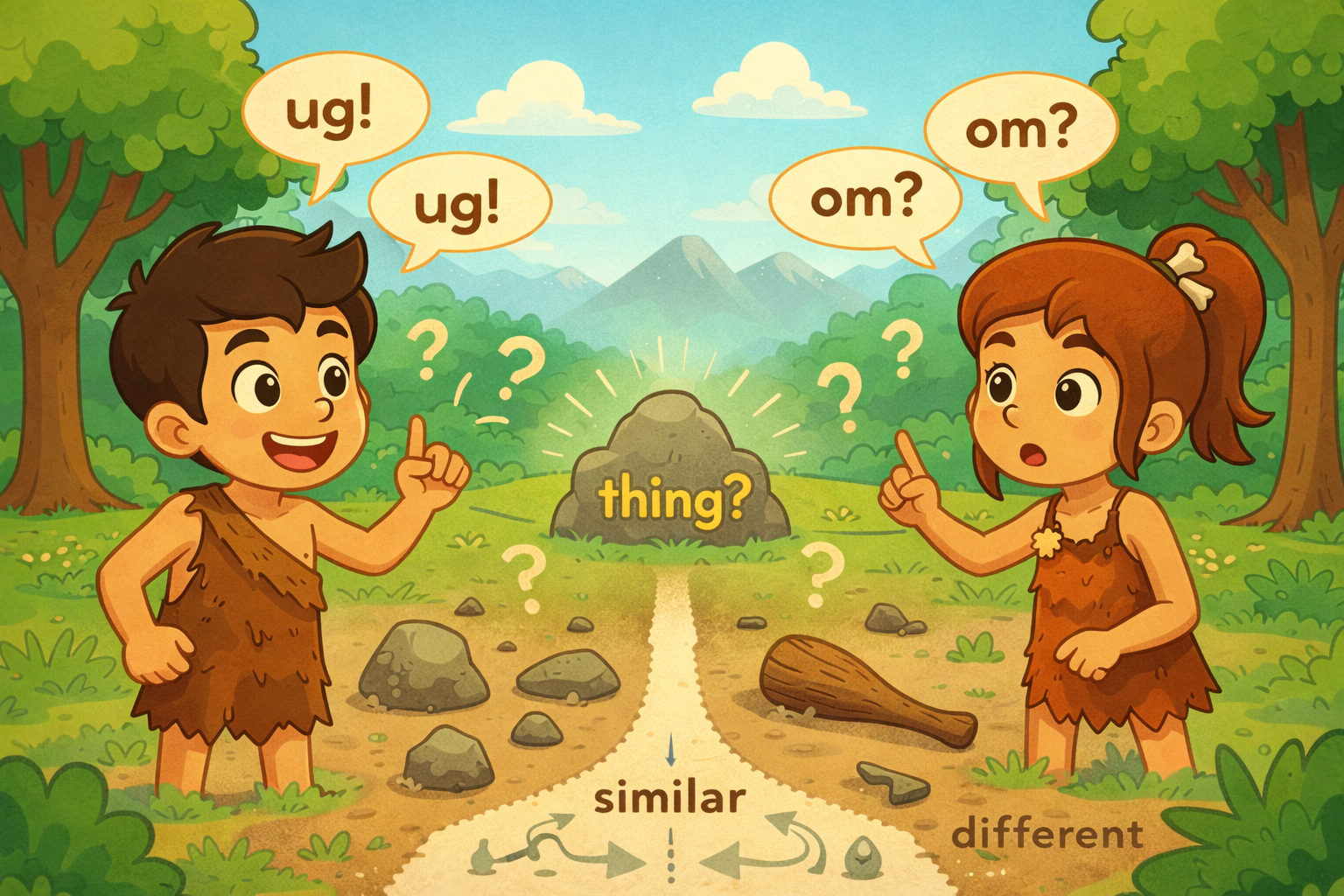
The critical point, then, is this: The ability to distinguish similarity from difference.
At first, I focused on sameness, but I eventually noticed that no two things in the universe are perfectly identical. We simply accept very similar things as the same. Even here, we treat two things as equal while the difference between them approaches zero.
(For non-mathematicians: the difference becomes so small that we decide to ignore it.)
This similarity–difference distinction works in our minds almost like 0 and 1. A binary and fundamental structure. The simplest mechanism that makes thinking possible.
Of course, distinguishing similarity and difference alone is not enough to construct a language. At some point, we need a concept that is never fully defined but carries everything: thing.
Without defining things, or at least accepting “this is a thing”, the objects we compare for similarity or difference lose their meaning. This reminds me of sets.
To talk about elements in sets, we need equality and inequality. But before that, there is a meaningless yet necessary acceptance: “this is an element.” Structure gives rise to concept, and concept allows structure to become meaningful.
I may have complicated things a bit up to this point, but the conclusion I arrive at is simple: Perhaps there was no first word. But an undefined acceptance of “thing” combined with the distinction between same and different could be a strong enough starting point for language.
This is not a persuasive essay. I am not claiming to provide a definitive answer to how language began. But I do feel that I am now looking at the question from a different angle. Maybe this is not a completed hypothesis, but for me, it is a meaningful beginning.
At this point, I want to make two things explicit.
First, I am not claiming that what I describe here is the definitive explanation of how language truly emerged.
The question of how language began may, by its very nature, have no final answer.
This text is not a conclusion, but a hypothesis.
Second:
Even though this idea cannot be historically verified,
it does not have to remain purely abstract or untestable.
A thought experiment seems possible:
If two artificial intelligence systems,
exposed to no existing human language,
and capable only of making the most basic distinctions such as “equal” and “not equal,”
are forced to communicate with each other,
would they eventually develop shared and repeatable structures?
If such a structure were to emerge,
whether it could be considered a full “language” would be debatable;
but at the very least, it could be observed
whether a rule-based, meaning-carrying, shared system begins to take shape.
This experiment would not provide a definitive answer to the origins of language.
But it might suggest that the more relevant question is not
“what was the first word?”
but rather
“when did meaningful distinctions become shared?”
That is all for now. Until the next piece, take care. I would genuinely like to hear your thoughts and objections.
Comments
0Join the conversation
Please login or register to leave a comment.