Hello everyone, I hope you are all doing well.
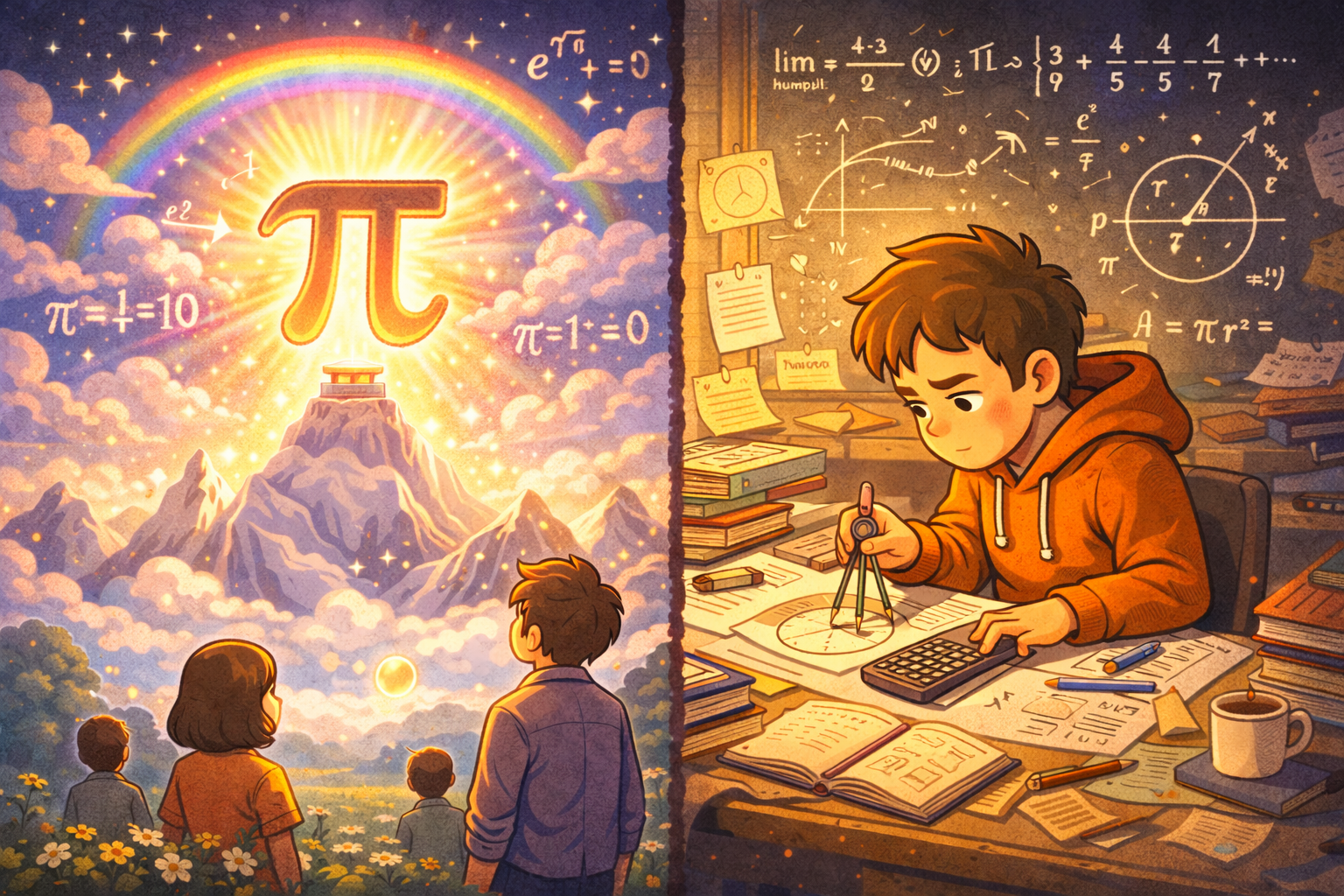
In today's post, I am here feeling a sense of obligation. Today is March 14. Many people consider today Pi Day because of the 03.14 date format. It is also celebrated as Medicine Day. So let me start by congratulating both groups.
So why do I say "I am writing feeling an obligation"? Because I realized that I don't write much about mathematical topics. I mostly explain my own philosophy and mindset. I thought maybe I should write a bit about mathematics today so as not to be rude. But looking around, I saw countless contents like "what you don't know about Pi," "its mysterious properties," and "magnificent formulas that give Pi."
Let's be clear: Most people share those series without really knowing what they mean or if they truly equal Pi. This makes me think about how much people struggle to understand the concept of limits and to grasp the difference between an approximation and the real value.
If I asked most of you "What is Pi?", you would probably give this answer: The ratio of a circle's circumference to its diameter. 3 in primary school, 3.14 in high school, 3.1415… going a bit further. Maybe an approximation like 22/7. And at your most respectful, you just say "π = π" and move on.
I, however, am not someone who loves geometry or looks for miracles in it. Therefore, I don't see Pi as a sacred symbol of a circle, a triangle, or trigonometry. For me, Pi is a constant that appears when taking volumes in integral calculations or in periods in Fourier series.
Sacralizing this number, calculating its digits to infinity, or believing that Pi is inside everything in the universe can sometimes turn into an unnecessary obsession in my opinion.
I was also obsessed with numbers at one time. I thought there were mysteries in them that only I could see. I even defined something called the "Ahd constant" to myself at one point. Then I saw that the 12th power of the golden ratio, Euler's number, this, that… I can somehow connect them all. Because you can connect everything to each other if you want to.
Some people who argue that we can completely understand the universe with mathematics sometimes impose such things on others. However, for people who cannot attach meaning to it, mathematics just looks like the mania of eccentrics speaking in strange symbols.
But the purpose of mathematics is not to look mysterious or to be a sacred thing anyway. Mathematics is a tool that helps you build models and understand with its internally consistent structure.
But humans often see what they want to see. Just as codes in a programming language mean nothing on their own, but turn into a system that allows you to read this article right now when arranged in the correct order; mathematical symbols and constants only gain meaning in the right context.
In summary, instead of looking for miracles in Pi, e, or the golden ratio, try to understand what they are useful for. Their applications might seem complex, even meaningless at first glance most of the time. But at least being able to say "It's useful for this" is more valuable than just saying "It has very cool formulas."
After writing such a harsh article, let me make an exception. Let me also talk about a structure in mathematics that is feared but actually very beautiful: i. This number, which allows the establishment of complex numbers, is much more interesting than a sacralized constant. Because it is based on this question that bothers people's minds:
"How can a number multiplied by itself be negative?"
The answer is actually very simple: It can be if we want it to. We define such a structure and work with it.
One of the sweetest formulas of mathematics born from this structure, in my opinion, is this:
eiπ + 1 = 0
In this formula, many fundamental constants of mathematics come together: e, π, i, and also the fundamental numbers 0 and 1.
But the human mind still asks this: How do you take the iπ power of a number? This becomes possible thanks to Taylor and Maclaurin series. With the help of these series, we obtain this relationship:
eix = cos(x) + i sin(x)
In high school, they used to make us memorize this as "z = r cis(θ)", and I used to get incredibly annoyed back then. But later, as I saw where it came from, I started to like this structure.
Let me finish without dragging the topic out too much. I hope this article has made you think that it is more valuable to prefer understanding mathematics rather than looking for mystery in it. Wishing you to be among those who ask "What is this useful for?" rather than those who say "This number is very mysterious."
Take care of yourselves until our next post. See you later.
Comments
0Join the conversation
Please login or register to leave a comment.